HAPPY 2026!

Dear friends and colleagues,

Happy New Year!

One of the most beautiful things of 2025 was our encounters at concerts and rehearsals — across more than a dozen countries and two dozen cities where I worked this year. In total, there were over 100 performances of 24 different works at Carnegie Hall, Musikverein Wien, Kölner Philharmonie, Boston Symphony Hall, SFJAZZ Center, and other wonderful venues.

I wrote three works in 2025 — Four Faces, Four Wings (Gulbenkian Foundation, Casa da Música Porto, and Philharmonie de Paris), Love Canticles (Boston Symphony Orchestra), and Cardinal Directions (Van Anh Vo and Kronos Quartet, with support from the David Harrington Research Fund).

The Knock, my opera with a libretto by Deborah Brevoort, also found its way home in 2025. While composing the opera in Novi Sad, I imagined Colorado Springs — the faces, the sky, the Rockies rising at 6,000 feet — and Fort Carson, where the story unfolds. Returning to this community to share the work was deeply moving, not least because nearly everyone I spoke with had lived some part of its reality or carried it through someone close to them. The piece traces the long arc of war’s aftermath across generations and geographies, from my own family history to the echoes of the 1999 bombing of Serbia, as a reminder of how intertwined these stories are, and how essential it is to give musical voice to children and families who grieve mostly unseen.

Among the special moments was the ECHO Rising Stars Tour with the MAAT Saxophone Quartet across Europe, and the New York performance of Gold Came From Space with Kronos Quartet.

The year also included sharing my work with composition students at the Cabrillo Festival of Contemporary Music, New York University (Composers Forum with Julia Wolfe), and the San Francisco Conservatory of Music (Composition Seminar with David Garner). I gave my introductory lecture as a newly elected member of the Serbian Academy of Sciences and Arts titled Sound as a Space of Memory and Healing: Compositional Approaches in Works Addressing Contemporary and Historical Political Turmoil.

Critical reception included reviews in The New York Times and The Boston Globe, as well as a feature in San Francisco Classical Voice. I was honored to receive the Darinka Matić Marović Award at the KotorArt Festival in Montenegro for continuous contribution to the contemporary music scene throughout the region of ex-Yugoslavia, as well as the ASCAP PLUS Award for 2025.

Xenia and the Bishop, for wind quintet and narrator, commissioned by the Fromm Foundation and performed by New York’s Sylvan Winds with Mary Beth Peil, was released by Albany Records on December 5 on Resonant Worlds. It is a musical fairy-tale about a passionate chess player — I think children around you would enjoy it!

Looking ahead to 2026, the next deadline is approaching fast — a new work for my old, dear collaborators, the Brooklyn Youth Chorus, for the group’s 35th anniversary. I continue teaching at a composition studio at the Academy of Arts in Novi Sad and contribute to the Serbian Academy of Sciences and Arts through a project on the global presence of Serbian concert music in the first quarter of the 21st century (if you feel like contributing, do get in touch!).

In addition to Novi Sad and New York where you’ll be seeing me a lot, I hope we cross paths at the upcoming performances of Four Faces, Four Wings at the Philharmonie de Paris, the Elbphilharmonie, in Lisbon, Barcelona, or in Iceland with the MAAT Saxophone Quartet.

Thank you to all of you who performed, commissioned, and presented my work. I look forward to more of our exchange, inspiration, and music making, and I wish you health and joy in the New Year!

Cheers,

Aleksandra

aleksandravrebalov.com

ANTENNAE

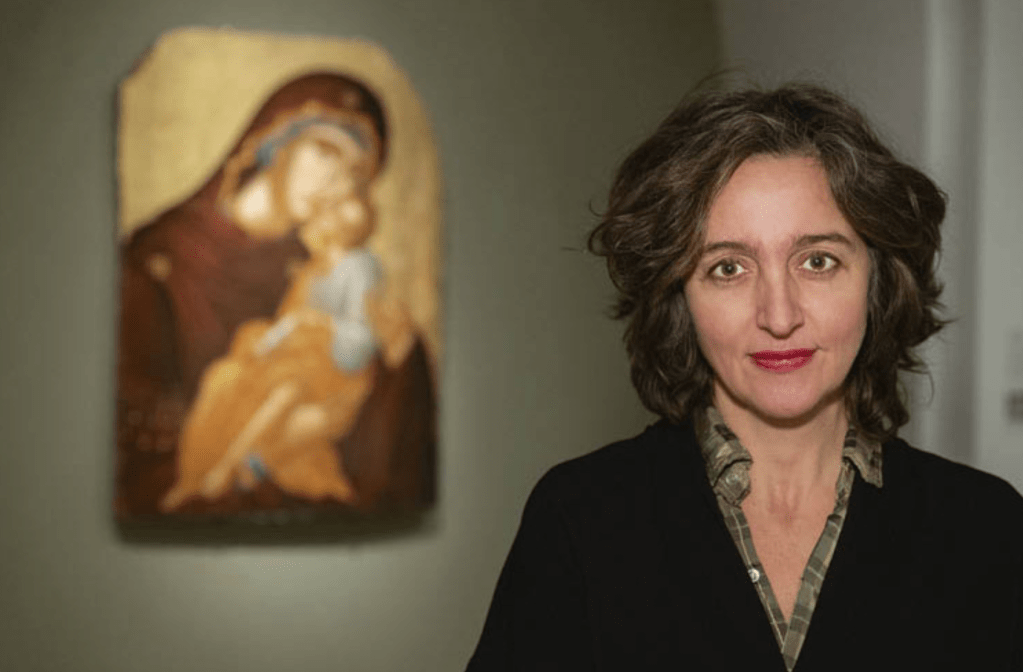
 Antennae was inspired by the icon of the Virgin of Tenderness (Virgin Eleousa), which dates from the period of late Byzantium (1425-1450) and is in the Byzantine collection of the Cleveland Museum of Arts (USA).

The world premiere of Antennae by Aleksandra Vrebalov is the third in a series of compositions commissioned by the museum in partnership with the Cleveland Foundation. This evening-long sound experience features Cappella Romana, 25 local singers, four trumpets, a string quartet, two organs from the museum’s collection, and percussion, with visitors dispersed throughout the galleries. Due to the specific architecture of the museum, the sound will travel and mix, reflecting and resonating.

It’s a composer’s dream to create a work with no limits on instrumentation, duration, or subject matter. For my Creative Fusion residency, the only requirement was that my work be inspired by the museum’s collection. I felt like I was given permission to dive into a gigantic treasure chest and search for the sound of the most beautiful objects of imagination and intellect across humanity’s history.

Upon my first visit to the museum in October 2018, I endeavored to understand how time and energy flow throughout the campus. I admired the architecture as much as the artifacts. The vastness of the Ames Family Atrium supported clarity and bold thoughts. Airy and bright, it felt like a place of decompression after the denser energy of the galleries. I imagined the museum like a walk-through music box, resonating in a way not heard before: with sounds played simultaneously through galleries and building up over time. Each person’s level of participation and choices of direction and speed in moving through the space would determine their unique perspective and listening experience.

In the arched, intimately lit Byzantine gallery I felt an immediate connection: there she was, the Virgin Eleousa—the golden hue, the iconography of an embrace with cheeks touching. It was familiar and reminded me of home. I grew up in Serbia (then Yugoslavia) during the socialist regime. Institutionalized religion was not part of my generation’s upbringing, but almost every home had an ikona. In the culture rooted in Eastern Orthodoxy that flourished during the Byzantine era, icons were not seen as objects. They were portals, powerful facilitators of miracles and healing. I wondered, standing in front of the Virgin of Tenderness, how many objects in the museum have had the same dormant power revealed to insiders, while the rest of us walked by, merely appreciating their material attributes and their historical and aesthetic value.

The aural counterpart of an icon is a chant; these two millennia-old forms are, within Byzantine tradition, considered portals to another realm. Chants are not songs but rather sound codes transmitted by choros, a choir consisting of everyone present, musician or not. In fact, in 2019 UNESCO announced the inclusion of Byzantine chant on the list of Intangible Cultural Heritage of Humanity.

My connection to Byzantine chant is also personal, through a small monastery in northern Serbia. Its two dozen monks begin their day with a 4:00 a.m. service, make candles and jar honey, cook meatless meals, and keep the ancient musical tradition of Byzantine chanting through their services and choir practice. Over the years I have had the privilege of attending liturgies followed by simple meals in the monastery. The uniqueness of that relationship inspired the idea of reuniting the living chant with the icon.

Antennae is a malleable, organic sound situation rather than a fixed piece of music. It is a human tuning fork through which we align and for a moment sustain a common frequency. In our divisive reality, it is still possible to tune in to this other, nonverbal level and to feel what it is like when we harmonize. All different sounds from various galleries will come together like pieces in a mosaic completing the total aural landscape. The sound becomes a connecting thread, a buzzing flow of breath and frequency regardless of one’s decision to join in or stand by.


Through this process of listening and aligning with others, I hope we each feel connected a little more. The journey begins with Virgin Eleousa enveloped in Byzantine chant; it unfolds with dozens of voices humming one tone throughout the galleries and ends in the atrium, with our identities and values falling, if briefly, under a unifying category of humans, lovers of beauty and art. On this human plane of existence our only tangible way to experience love and beauty is through our harmonious relations with one another. Listen for a hum and join in.