on arts and politics

The Mac Dowell Colony Newsletter Peaceful Measures, 2008

Composer Aleksandra Vrebalov interviewed by Brendan Tapley

Five years ago Aleksandra Vrebalov, a Serbian composer who now lives in New York, formed a collective with five other composers called the South Oxford Six. Their name — slightly infamous-sounding — is fitting. Under the guidance of Vrebalov, the group decided to put its artistic energies into political action by connecting American composers and students with Serbian audiences and creating music that fused he two. Hoping to “decentralize the Serbian culture” and reconcile the resentments for the NATO countries that bombed the former Yugoslavia in 1999, Vrebalov says her activist plan, now government funded, aimed for “a higher form of exchange that is spiritual in nature.” Art and art organizations, she believes, tend  to “fix things governments do.” The sincerity and altruism of Vrebalov’s newfound mission is affecting. Above and beyond that mission, what she seems most passionate about is the unique way art invites critical introspection into human life, that same introspection that guides conscience, empathy, and the ability to understand — three traits that might diminish a great deal of conflict, personal or international. Though music is the means and result of the collective, it seems that introspection is the goal of the exchange program. In this confrontation with the self, art becomes a handmaiden of humanitarianism. It is a formula Vrebalov bases on her own life: “Being away from my country and becoming more rooted in this one gives me enough insecurity to question things,” she says. “And when you have to redefine your identity, you also have a strong urge to understand your origins, your place.” And the origins and place of others. We spoke to the composer recently about her work.

What do you believe the link is between art and political reconciliation?

I believe that there is a homo politcus in each of us, so creating, for me, is in part a way to respond to the social environment and to deal with events and emotions specific to the moment. In the arts, we have a luxury of creating worlds in which real-life tensions and dramas become abstractions, available to us to mold and manipulate. In that imagined, staged world, we can relive hatred, loss, shame, humiliation, with enough distance to recognize them as universal and shared across the war lines. And this is how we humanize those who are, according to our governments, our enemies. From the moment we realize we share that humanness, we are more open for acceptance and compassion, and eventually for reconciliation.

What about the Serbian conflict inspired you to take up this artistic challenge?

Coming from a place like Serbia, where it has been impossible to separate individual identity and destiny from the collective one — because of events such as the totalitarianism of Milosevic’s regime, nationalism at its extreme, and several wars — writing music turned out to be a way to process and cope with what has been going on for all of us over there.

So this has shown up in your own work?

Yes. In the specific case of … hold me, neighbor, in this storm … [Vrebalov’s work, which premiered at Carnegie Hall in March 2008], I wanted to merge musical languages of two antagonistic ethnic groups (Serbs and Albanians) and create a world in which they can coexist and complement each other. The challenge was to use the elements of their individual identities, such as religious symbols and ethnic instruments, and to fuse them, wed them, in a union impossible otherwise. Therefore, the powerful attributes of both Serbian and Albanian nationalism, which over the years had fueled a dark passion to exclude, become in the piece just  the opposite: the binding, structural elements of a rather striking union in music.

In terms of your exchange program, what specifically have you detected about how art can heal those you’ve worked with?

We do not cry because music is sad, we cry because there is sadness in us, helped by music. So, art has its ways — subtle, yet direct; irrational, yet steeped in our most concrete experiences — and when we are exposed to it in a ritual of performance, we know we are protected by boundaries of that ritual. We feel safe and open to emotions.

Do you think governments, political systems of any kind, would benefit from enlisting art in conflict?

In an ideal world of responsible governments, reaching out to artists and intellectuals would be a part of the prevention of conflict rather than post-conflict reconciliation. The benefits would be about inclusion and treating “the other” as an equal partner in keeping the peace, rather than a threat. So, government-supported cultural programs could contribute to a better mutual understanding of groups. In real life, however, it is a super-sensitive issue, and a very problematic one. Art’s power, I believe, lies in an artist’s readiness to deal with intimate concerns and views on the world that, in the process of creation, exclude the public and certainly exclude  governments. So, as an artist, I want to distance myself from my government and to counteract its doings by creating ways of dealing with political crisis. Art in the hands of government can be in danger of becoming a defender of ideology. Depending on the political agenda, it can be equally effective in both propelling the conflict and helping the process of reconciliation.

Aleksandra Vrebalov has written chamber, vocal, orchestral, and ballet music. She has received honors and commissions from Carnegie Hall, the American Academy of Arts and Letters, Barlow Endowment, Merkin Hall, Kronos Quartet, and Festival Ballet Providence, among others. Her residencies include The MacDowell Colony, Rockefeller Bellagio Center, Tanglewood Music Center, Other Minds, and American Opera Projects.

Peaceful Measures, 2008

printed version page 14

The Knock – an Opera

I have written three operas: The Knock (2020), commissioned by Glimmerglass Opera Festival and Cincinnati Opera, Abraham in Flames (2019) commissioned by N Talebi Projects and premiered in San Francisco in 2019 and Mileva (2011) commissioned by the Serbian National Theater in Novi Sad and premiered during its 150th Anniversary season.

The Knock, my most recent opera tells a story of a group of military wives, whose husbands are fighting in Fallujah. They gather together because of rumors about a possible incident on the war front. As the women await word about what has taken place, a young Army officer drives across the western plains to deliver them the news. A sixty minute opera for three soloists, a chorus, and a chamber orchestra, The Knock takes the audience into the lives of America’s military spouses, a group not yet seen on the opera stage.

Cincinnati Opera – In Performance:

“The Knock” explores the friction between patriotism and personal loss, highlighting the sacrifices made by military families and the cost of war – the loss of human life. The dramatic narrative of the opera allows for an extreme range of musical expression, from tender and lyrical to horrific and solemn.  I use a full palette of sound and harmonic density to draw on the deeply felt emotions of the protagonists of the opera.

As a composer, I’m sometimes asked who I write for, but I often do not have a specific audience in mind. However, while composing “The Knock,” I found myself thinking about military wives and families who might be in the audience. It was an honor to be their voice and to express the emotions of loss, strength, and resilience through music. My hope is that this music offers insights, healing, and a deeper connection to a reality that is both urgent and relevant, even if it’s a reality that is extremely difficult to face.” Aleksandra Vrebalov, June 2023.

Music by Aleksandra Vrebalov. Libretto by Deborah Brevoort. Stage direction Alison Moritz. Music direction Lidiya Yankovskaya.

About The Knock

Questions by Glimmerglass Festival, January 2021

-What is your show about?

The Knock is an opera about military wives receiving a death notice.  It’s a fascinating world – pretty much hermetic, hidden from the outsiders, driven by protocols.  Suffering and heroism, sacrifice and privilege, personal and public sphere, joy and sorrow – all coexist in extremes.  I grew up in a family of WWII heroes, my dad is a WWII orphan, the only child of my grandparents, who both died fighting fascists.  I grew up having a strong sense of pride for being from a family of patriots, heroes who gave their lives for the country. At the same time there was so much personal, behind-the-scenes grief that marked the family because of the loss of lives.  While writing the Knock I wanted both aspects to be honored – the public, stately side – heroic sacrifice, along with what happens on the inside – the rawness of a personal loss.

-Why do you think this is an important story to tell in 2021?

I believe that any story that inspires us or concerns us as awake citizens is an important story to tell. Its relevant because it deals with our values, with what’s important to us.  In this case, it is the friction between patriotism and personal loss, the topic itself, the cost of war.  But for me, it is also about the families who make sacrifices.  Sometimes I would be asked as a composer – who do you write for, is there some imaginary audience you’re addressing. And most often I wouldn’t  have an audience in my mind while I write music.  While writing the Knock, however I was surprised how many times I thought of military wives and families sitting in the audience.  I felt the privilege of being their voice, to express in public the emotion of loss, also of strength and resilience.  If for anyone, I wrote the piece FOR them and I did my best to be a just, sensitive, responsible medium.  

-Why does this story need to be told as an opera piece? 

Opera – drama in music – is an adequate medium to contain and express the wide range of intense emotion that our story carries. I actually cannot think of a more perfect form for this story to be told – opera does its magic both through the language, verbal language AND music.  The sound of music unlocks our ability to feel and make emotional connections in more immediate, non verbal ways.  So we can have insights, heal, relate to reality in a more profound way.

-Have you learned anything interesting as part of the process of researching / writing this piece? Has anything surprised you?

I learned about the power of protocol in the military.  The Knock is really driven by the protocol – its’ not a random set of events.  The protocol gave it a structure, but then like in life, the emotion seeps through it and makes it personal.  Deborah did so much research and spent time with women, the military wives — it felt in the libretto there were real people.  Working on the Knock was very emotional for me.  Maybe also because it entirely coincided with the pandemic and the quarantine. I’ve been by myself, with no distraction and steeped in the feelings of my characters. 

Has anything surprised you?

What surprised me most is that I realized at some point along the way that I actually believe that The Knock, as dark as it is, can be a soothing, vibrant experience.  I still believe that.   

History with Glimmerglass:

I was the first Douglass Moore composition fellow almost 20 years ago and spent the summer at Glimmerglass learning about nuts and bolts of opera. I fell in love with the opera house in the fields, I was present at all rehearsals of Mines of Sulphur as an observer, I stayed over in Cherry Valley.  I remember white rocking chairs on the veranda of the Otesaga hotel – it was so elegant and so American. Twenty years later,  I am American too, and my connection to opera only deepened since those days, I have written three so far.  I had hoped back then that one day I might be back with my own work.  In so many ways, this is a dream come true, and I am very grateful for it. (Aleksandra Vrebalov)

our true wealth

Within a year, by coincidence, i made music with teenagers at the Royal College of Music in London, in the Middle East at the Flying Carpet Festival, and in San Francisco, where a girls’ choir carried a main role in my opera Abraham in Flames.  These teenagers come from three continents and very different life situations spanning from exile, war, and refugee camps, to growing up in liberal western metropoles.  They are beautiful and inspiring and have in common an undiluted urge to belong, love, and give their best.  If anywhere I have felt a sense of purpose, it was in their laser-like presence, soaking in information.  They are our ticket to survive, globally! Encourage them, the kids around you, to love the planet, to make friends, and to strive for excellence in whatever way available.  

Here’s a video recording of the show we did with young Londoners for the English National Ballet, performed at Sadler’s Wells Theater in London on April 7, 2019. Enjoy the show, choreography by Malgorzata (Gosia) Dzierzon, Renaud Wiser, Aaron Vickers, Katie Cambridge, and Hubert Essakow.

CLICK TO WATCH: https://vimeo.com/345500089/955f816482

CLICK TO WATCH THE VIDEO: https://vimeo.com/345500089/955f816482

Alice’s Chairs

On Chairs Alive! an installation by Alice Wingwall at Gualala Arts Center, May 2019

Alice’s chairs are of course – chairs alive.  Everything about and by Alice is filled with life – her laughter, colors of her wardrobe, her inquisitive ways, and her art.

Stepping into the lobby of Gualala Arts on Sunday felt like walking into a strange, eccentric world of seemingly disparate objects combined together.  It was a funny, mysterious, adventurous, busy, metaphysical, sturdy world – all at once.  If you know Alice, you know that chairs, gloves, cameras, shoes, clamps, guide dogs are all defining nouns.  Add architecture —especially images of iconic buildings carrying histories of humans creating beauty like museums and cathedrals, add reflective surfaces and crystals, add sky – you’re in Alice’s world.  It’s an abstract universe created by concrete elements of everyday life objects and imagery, and put together with precision and discipline.  Its multitudes of narratives are hard to define, yet they are obviously there and feel strangely familiar.    

There’s a stack of plastic chairs with clamps and yarn on them; there’s a series of photos of a floating chair in a pool, there are wooden hands resting on a chair, on one hand another tiny chair attached as a ring, there’s a chair with black large wings on it (Wingwal of course), chairs with shoes attached to them, or chairs resting on shoes, like they’re ready to take a walk, or take you for a walk.  

In the lobby of Gualala Arts Center all of them face in different directions, non-conforming to a point of view defined by the main entrance.  They ask a viewer to move in space, see them from multiple angles, come closer or bend over to not miss a detail.  More time one spends with them more there is to see.  The consistent use of elements (objects) throughout the exhibit establishes the vocabulary and depending on the context, a chair becomes a frame, a container, a vehicle, a throne, an invitation, or a portal to some other place.  

As I walked among them and read the descriptions that always involve snippets of memories of places and people surrounding the creation, Alice was guiding Donlyn in how to reposition one of the objects.  He would move it, describe the result, Alice would edit further, Donlyn would move it again, describe the new result, and that went on for a while.  

The exchange I observed brought a realization profound in its simplicity – Beethoven didn’t need to hear sounds of the physical world around him to write the most iconic pieces of his last opus.  He heard them IN himself before making them available to others’ ears.  In a work of art what we see as spectators is created by inner vision of the artist, and in Alice’s art that vision is entirely independent from the external, physical aspect of seeing. The translation from inner vision to what we (get to) see is what excites me about her chairs.  These alive chairs have existed in a world encumbered by physical reality of gravity (that’s why they sometimes float in the air too), size, weight, purpose; seeing how they translate to the physical world is as beautiful as it is striking, especially considering the consistency of the language within which the translation happens.

Alice Wingwall: Garden Party Preview, 2013 (from Wingwall’s website)

The Sea Ranch, CA, May 15, 2019

More on Alice Wingwall here: http://www.alicewingwall.com/work.html

World Premieres This Spring

Here they are, premieres of six works March through May 2019!

March 7 – 9 The Laughing Garden (2019) with Dusan Tynek Dance Theater. Choreography by Dusan Tynek. Prepared piano four hands, wooden flutes, vocalizing – Aleksandra Vrebalov and Luciano Chessa. Baruch PAC, New York City. For more on this collaboration see here: https://aleksandravrebalov.music.blog/2019/03/03/the-laughing-garden/

April 6 Pianist Dale Tsang premiering INDIGO CODES (2019) at the San Francisco Conservatory, as part of Ensemble For These Times Film Noir concert, San Francisco, CA. More on this concert: https://sfcm.edu/performance-calendar/event/film-noir-project.

April 7 English National Ballet – Dance Journeys, The Uncharted (2019), Sadler’s Wells, choreography by Malgorzata Dzierzon and Renaud Wiser, music by Aleksandra Vrebalov, Orlando Jopling conducting, London, UK. The piece is inspired by female pioneers across fields throughout history.

Dance Journeys, English National Ballet – recording session with the Royal College of Music Junior Department, composer Aleksandra Vrebalov, conductor Orlando Jopling

April 14 Raleigh Civic Symphony Orchestra with Peter Askim conducting the world premiere of OUR VOICES (2019), Raleigh, NC. This 25 minute piece commemorates the centennial of women’s suffrage in the United States. More on this work here: https://aleksandravrebalov.music.blog/2019/04/02/our-voices/

May 9-12 Abraham in Flames (2019), two act chamber opera with Young Women Choral Projects of San Francisco. Music Aleksandra Vrebalov, Libretto Niloufar Talebi, Direction Roy Rallo. Z Space, San Francisco, CA. More on this work here: http://www.zspace.org/aif

May 23 Sylvan Winds and Daria Karic (actress, narrator) premiere the Harvard/Fromm Commission Xenia and The Bishop (2018) for wind quintet and the narrator at Kosciutszko Foundation, New York City. Music and story by Aleksandra Vrebalov. For more on this work see here: https://aleksandravrebalov.music.blog/2018/12/26/62/

Our Voices

I was asked by Peter Askim, the music director of Raleigh Civic Symphony Orchestra, to write a piece for his group. He said that the 25 minute work would have a virtual reality component built by graduate students of North Carolina College of Design, led by Derek Ham, on a theme of suffragettes.

In 2017 Peter gave the world premiere of my Echolocations in New York’s Le Poisson Rouge; we had divided a string orchestra into three groups to play an identical material, at different times, from three different locations in the hall.

The experience was magical, as if the sound were coming from all around the audience, echoing across space. Textures and volume mixed and merged right next to one’s ear as well as in the distance. There was a sense of oneness between the musicians/sound and the audience since the stage as a divide did not exist.

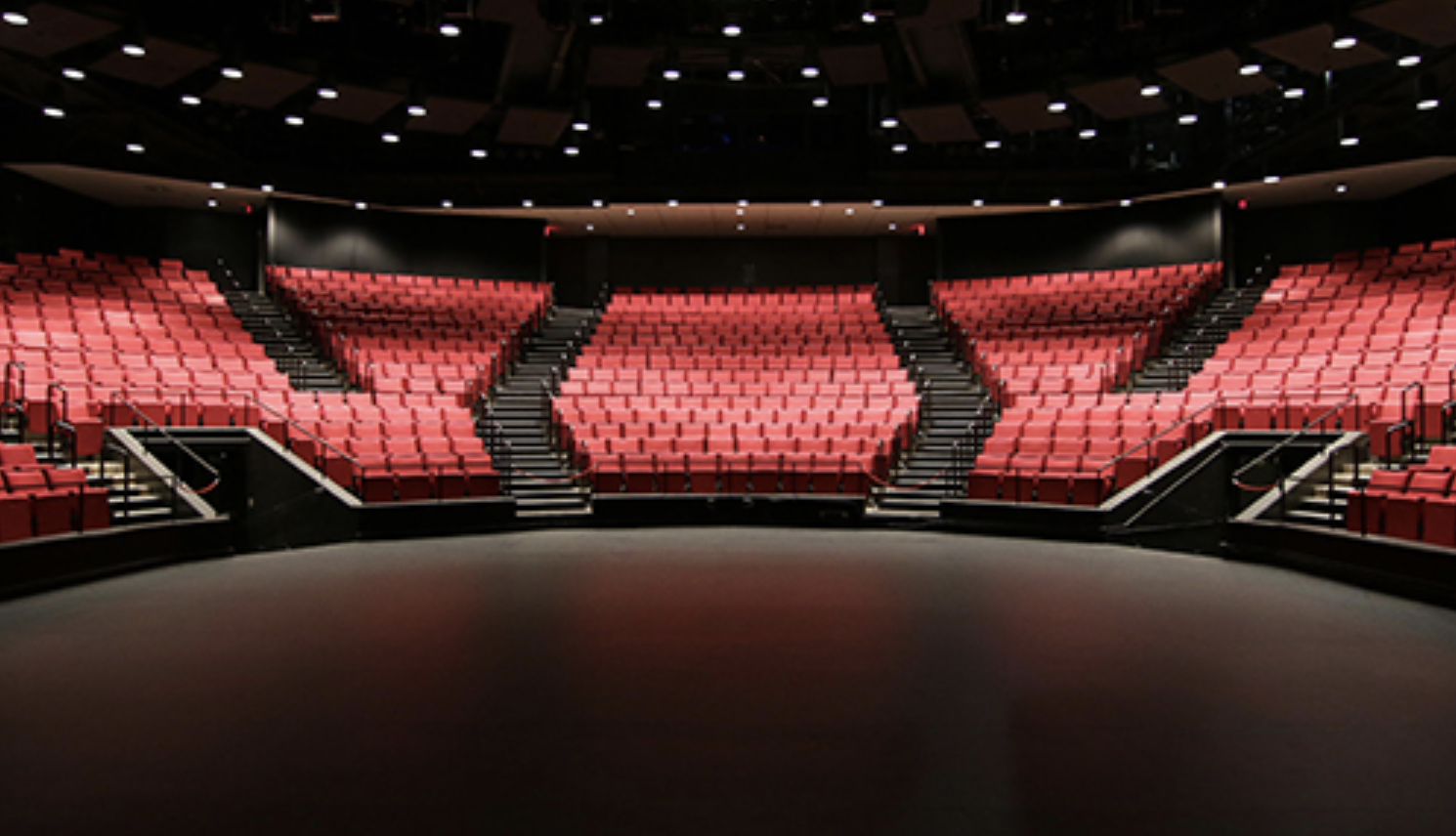
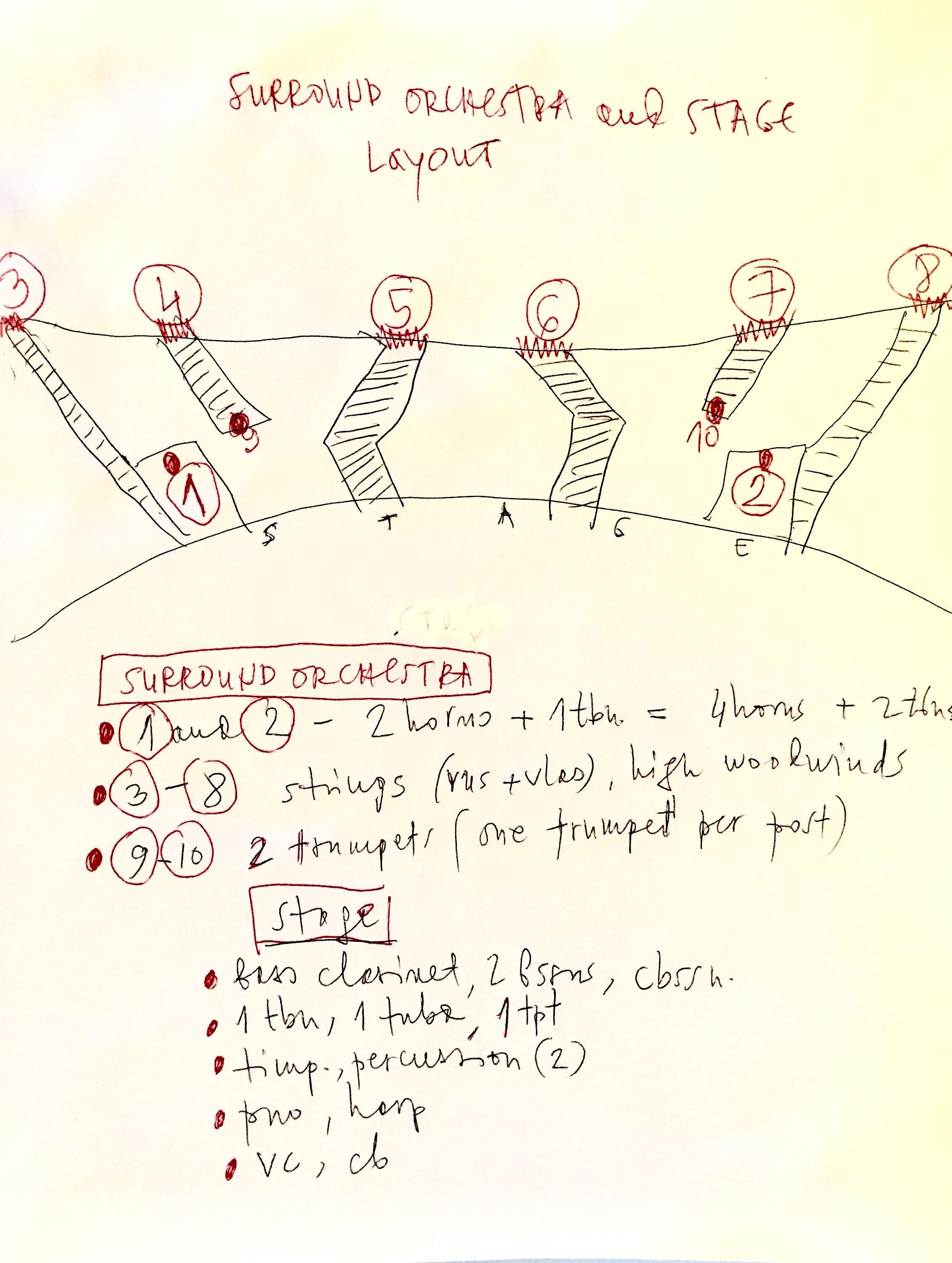
Peter asked me to do something similar with the new work – to spatialize the orchestra. It is a dream situation to get permission from a conductor (Peter is also a composer and a bass player) to break the standard layout of this gigantic body of sound and explore it. There were several things to solve: how to make musicians comfortable while away from their usual places on stage; how would they follow the conductor and be able to hear others if they are dispersed throughout the auditorium; would they like the idea of being challenged that way, since their experience is to belong to a group and play as a group; where would they stand in the specific hall that I never visited? I got photos of the hall – there was room to have musicians in different spots, so I decided to divide them into Surround and Stationary groups. Instruments that can’t move would stay on stage and be the Stationary orchestra, while the Surround orchestra with all portable instruments (high strings, woodwinds and high brass) would be positioned around the audience.

Stewart Hall where Our Voices will be premiered on April 14, 2019 by NC Civic Symphony, conducted by Peter Askim
Our Voices – distribution of instruments throughout the auditorium

The piece needed to be lean in terms of notation, as the lighting, stands, and all elements of the orchestral setup would not apply to this performance. (Also, Surround orchestra members would be standing for the duration of the entire piece.)

I divided the piece into six sections framed by Intro and Epilogue. In both Intro and Epilogue, musicians are asked to use their voices. In Intro, everyone gradually joins in a hum on A a cappella, while in the Epilogue the Surround orchestra members walk through the auditorium calling the names of women in their lives who inspired them: their grandmothers, mothers, sisters, wives, teachers…it’s a personal choice.

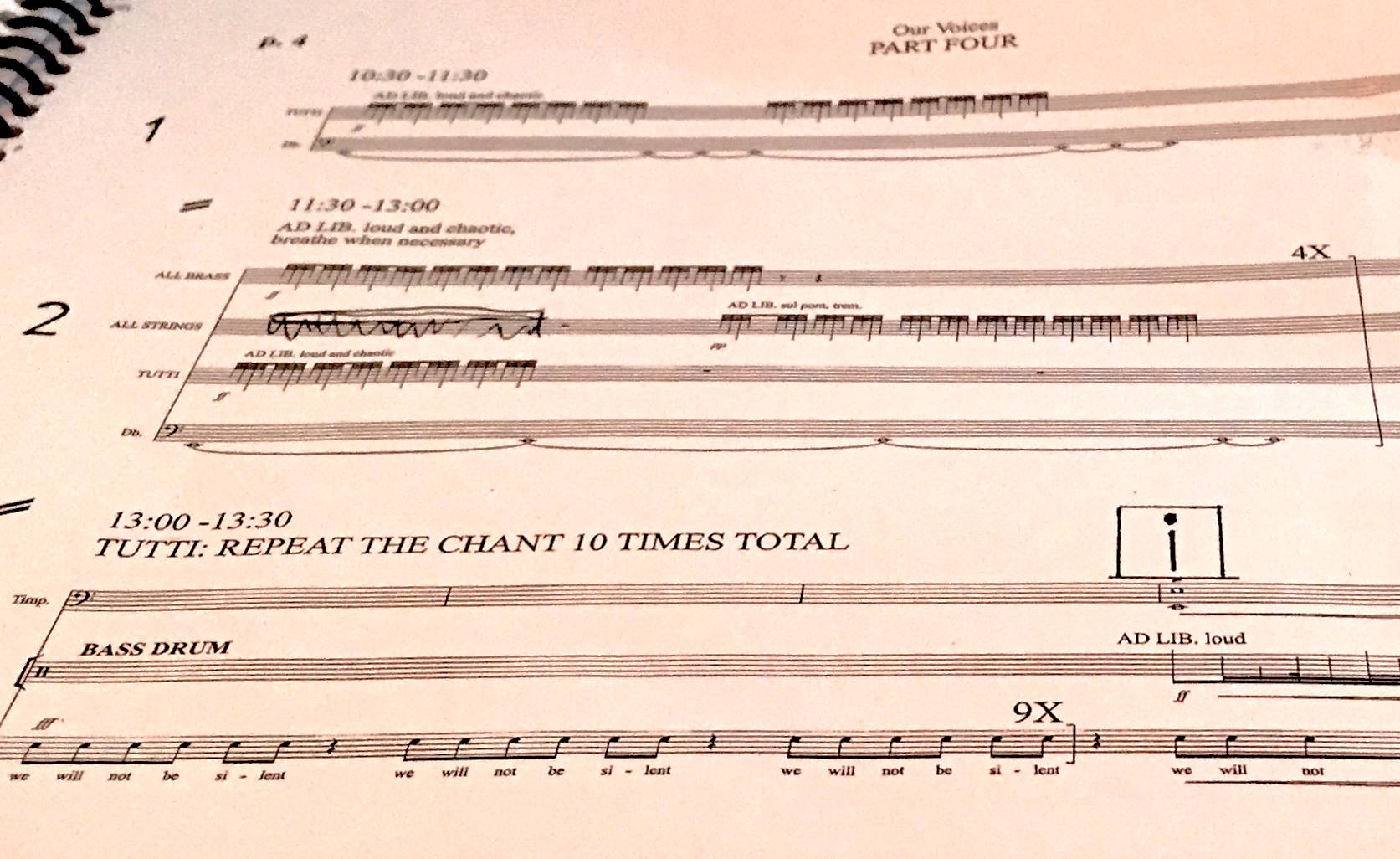
Aleksandra Vrebalov: Our Voices, excerpt from the score

Parts 1-6 are all organized around pitch centers (B, C, D, E, F, and G) so all musicians can come in and out of playing, knowing how to fit in harmonically. The score is open, no meter, mostly aleatoric, with options offered, but choices entirely upon the 80 people playing the piece. The role of the conductor is to keep time and organize transitions, while his gestures do not mark sharp beginnings or endings of gestures and sound. Transitions between the sections are fluid and overlapping.

Aleksandra Vrebalov: Our Voices, excerpt from the score

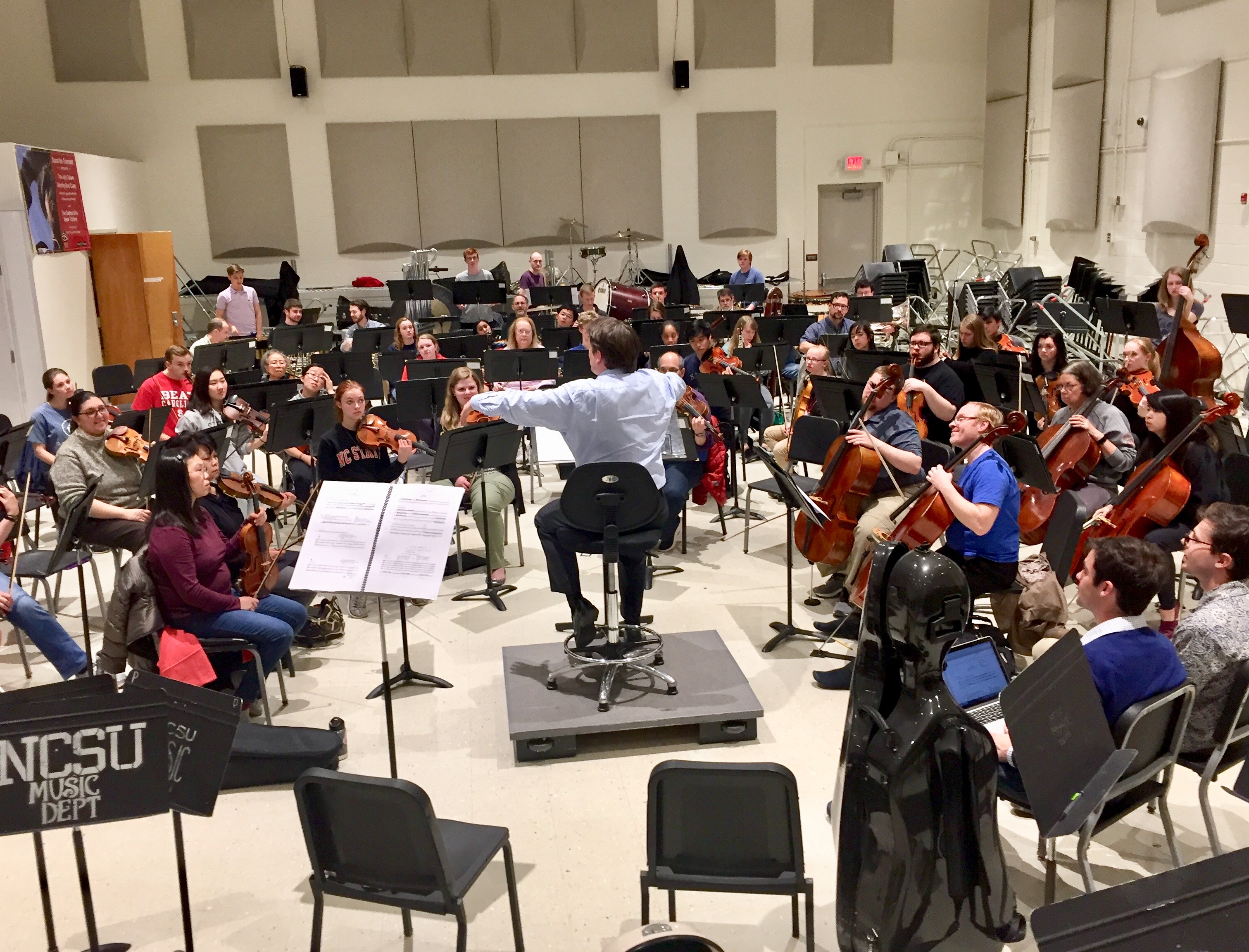
There were many interesting insights during our rehearsal in Raleigh, NC this week: most of musicians in the orchestra would start and stop immediately following conductor’s gesture although the instruction states – the conductor’s gesture means you can start from this point on at your own time; or with the ending – wrap up your material at your own pace and move onto the next thing.

The atmosphere during the one rehearsal I attended was inspiring – we were searching for new ways of individual expression, trying out new techniques not so common in the standard orchestra repertoire, understanding the concept of musical time in which there is no counting, but listening and responding instead, discovering ways to feel safe without the structure of barlines and meter.

Rehearsing with The Raleigh Civic Symphony, Peter Askim music director

In terms of rehearsal methodology, Peter had me talk to the orchestra about each section, then we played it through, worked on timing and explored sound, and played it through again. After going through the entire piece we were ready to try spatialization. The Surround orchestra members placed themselves around the rehearsal space, all of them behind the conductor – and we had the first run-through. The sound was traveling in all directions creating most beautiful, unexpected sonorities.

My favorite part was when the orchestra for a brief moment accompanied the recording of Billie Holiday singing Strange Fruit. Again, there was no meter, barlines – just Billie’s voice with her beautiful, free, out-of-time phrasing.

Peter and I had several conversations on how to make that segment with Billie Holiday doable for the orchestra. I didn’t want to transcribe the song with any specific metric or tonal changes. My idea was to have the orchestra follow her voice, rather than following the conductor. The very topic of the piece – the struggle for equality, somehow symbolically came up in the treatment of that sample from Strange Fruit: in an ideal world of citizens with high consciousness we would not need to be told what to do and whether and when to support the voice of another. By listening and doing our best to understand and support the other we would create a different humanity.

Peter’s concern for precision and clarity was a great reminder that I am creating a work for eighty people whose comfort and success in delivering that music also depend on how aligned they feel with one another and the recording of Billie’s voice. We were deliberating whether I should rewrite the score and instead of just saying ‘follow Billie, c-minor” write out orchestral parts transcribing the metric freedoms that she takes while singing. I decided against it. In this specific case I wanted each individual to take charge, be responsible for their choices, listen, try to provide support, swim in uncertainty if so happens, rather than follow the conductor. The invitation to the orchestra to join in freely around Billie Holiday’s voice in Our Voices calls for a personal, unique contribution of everyone involved in the piece, rather than an orchestrated, controlled response. The thinking through of those two options (lock it in a standard notation or keep it as open as possible) inspired me to write a poem about how I made musical choices in this piece. The poem also reflects on a larger context of what it means to belong to and to create our humanity. I dedicated the poem to Peter, who invited me and trusted me throughout this creative adventure.

Accompanying Billie Holiday in Strange Fruit

Do 
Not
Be
***
At
Me
I am like you
And you are like me
Doing my best
Often fast
Sometimes slow
Wanting all
And then some more
Creating order
Bliss or mess
Still true and real
Despite distress
Those Billie-lines
More than once
Made me cry
As I fit them
In odd times
Whole notes
Half notes
Aren’t wrong
They are 
Dark and lost
To song
Of pain and 
Crisscrossed time
No chance to
Truly align
Unless
We all agree
That 
What is yours
Is also mine
What was theirs
Was hers at times
Wanting best
Yet often failing
Feeling rough
Still trust prevailing 
Contrasts of
Wants and coulds
Of possibles and shoulds
No wiser thing
No greater power
Than seeing
With one’s heart
Into the dark hour
Of those Billie-lines
They might also
Make you cry
As you play them
In odd times

London, January 29, 2019, for my friend, collaborator, and a fellow composer Peter Askim.  

Our Voices, full recording of the world premiere. Raleigh Civic Orchestra, Peter Askim conducting, April

Our voices was commissioned by NC State University and NC State Sustainability Fund. Our Voices has been featured on NCSU Website:

https://news.ncsu.edu/2019/04/concert-blends-music-with-vr/?utm_campaign=concert-blends-music-with-vr/&utm_medium=referral&utm_source=ncsu.edu&utm_content=hp-hero


Le Jardin Qui Rit – The Laughing Garden

a new dance piece in the making

After months of traveling, I returned to New York on Thursday and started rehearsing with Dusan Tynek Dance Theatre on Friday for our new show, The Laughing Garden.  This is my seventh collaboration with Dusan over 15 years.  Our long creative relationship enabled us to expand and grow together trying out different ways to create a dance – from sound coming before choreography, to building music and choreography simultaneously, to choreography coming first, to the current approach of establishing the vocabulary and freely creating music and choreography together in real time, before your eyes. 

The Laughing Garden is inspired by Hieronymus Bosch’s Garden of Earthly Delights and is filled with moments of primal energy, joy, some darkness, a lot of playfulness.  

Detail from Garden of Earthly Delights, Hieronymus Bosch

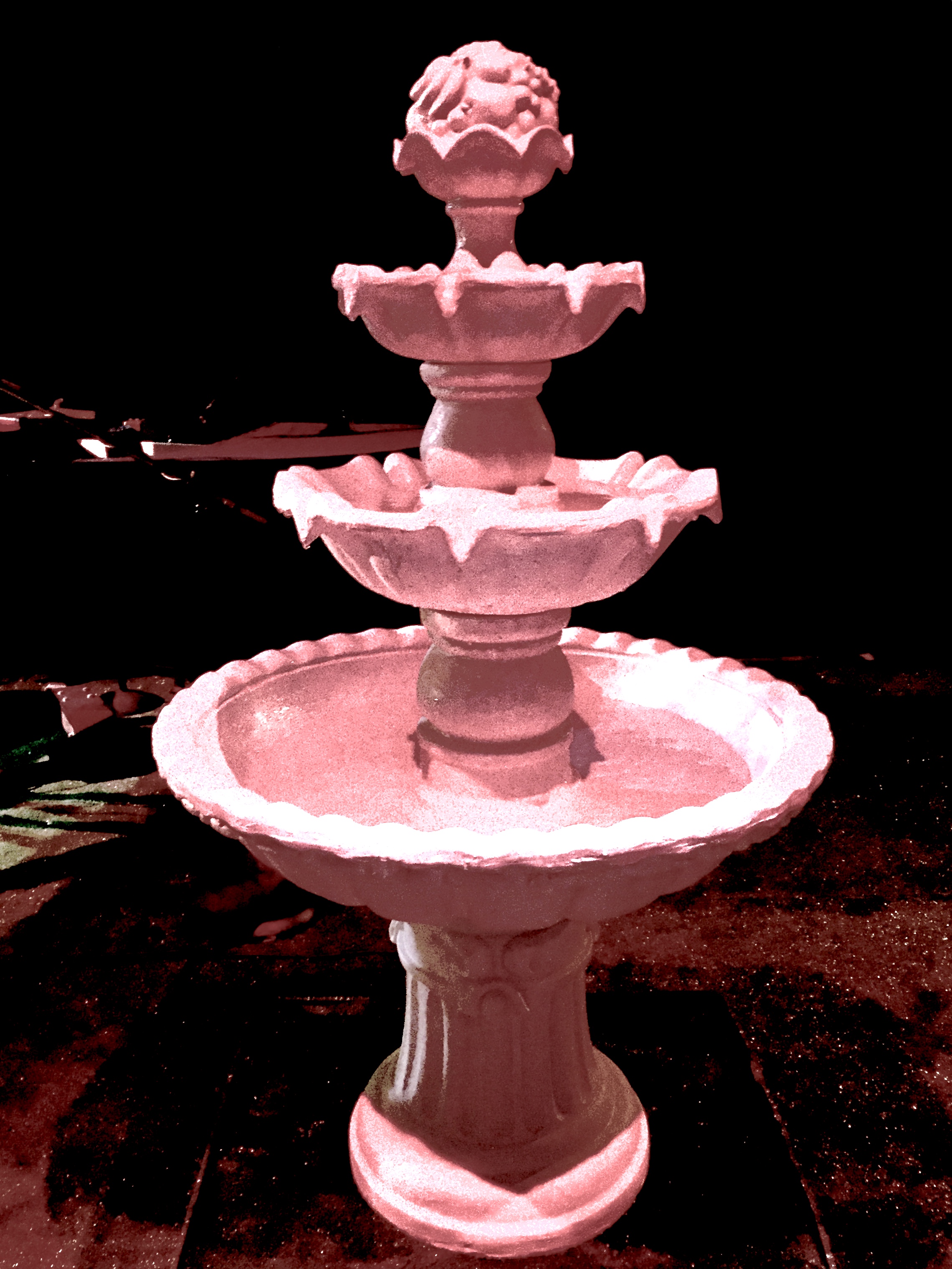
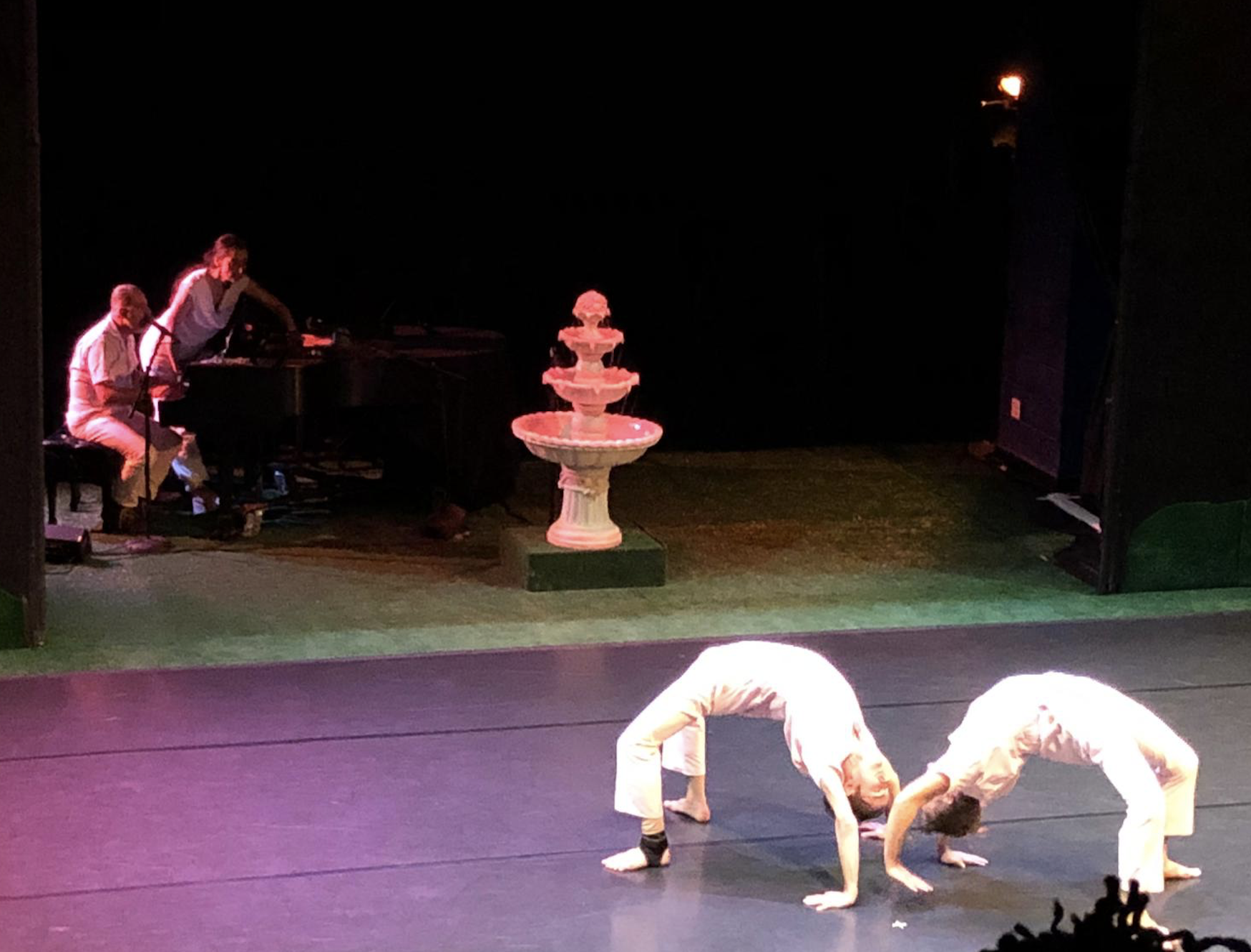
I am thrilled that my friend and a fantastic composer Luciano Chessa will join me in creating a live score for performances. We will be on stage with six dancers and make sounds on prepared piano and other objects, including a water fountain.

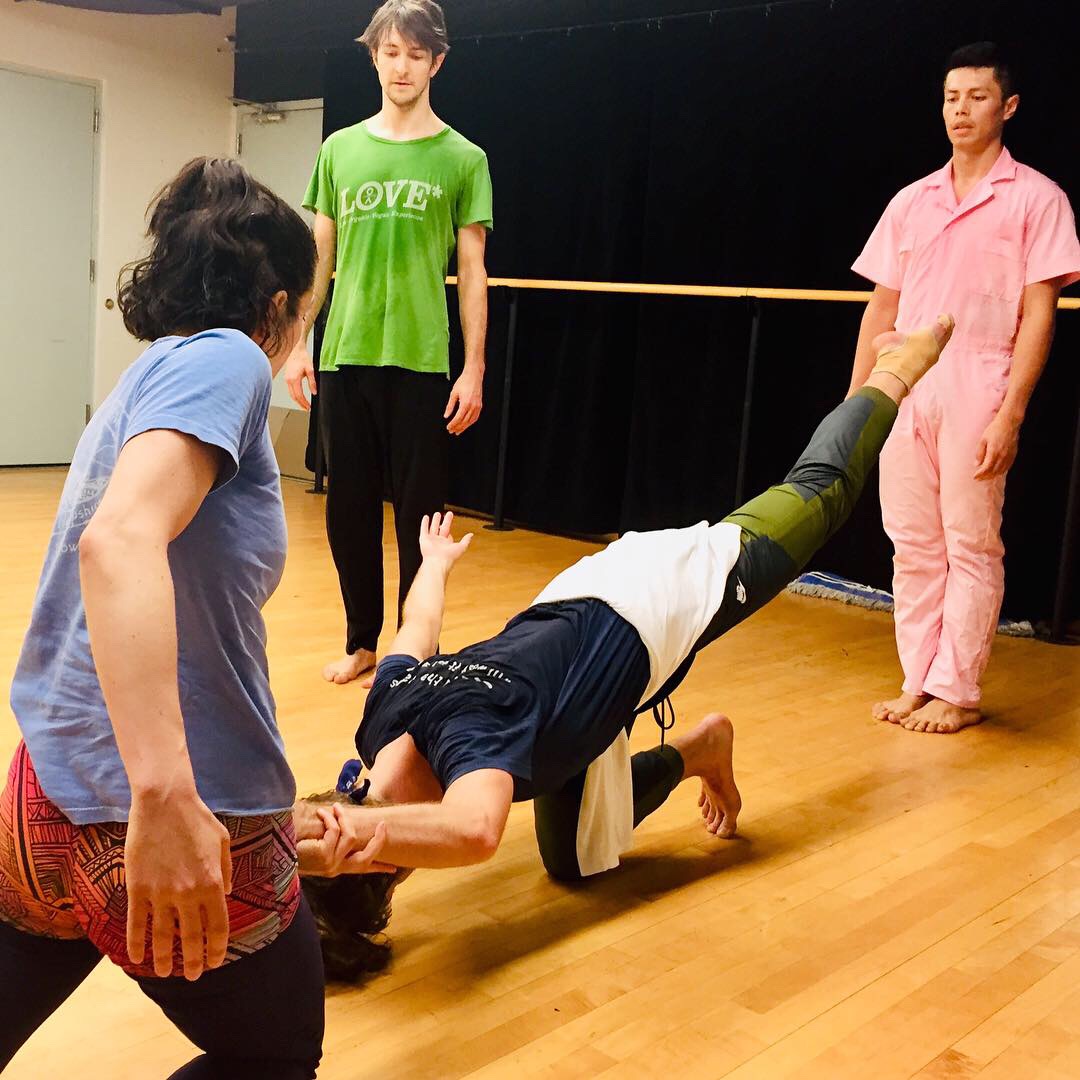
Alexandra Berger, Ned Sturgis, Tim Ward, Gary Champi of Dusan Tynek Dance Theatre rehearsing The Laughing Garden, March 2019
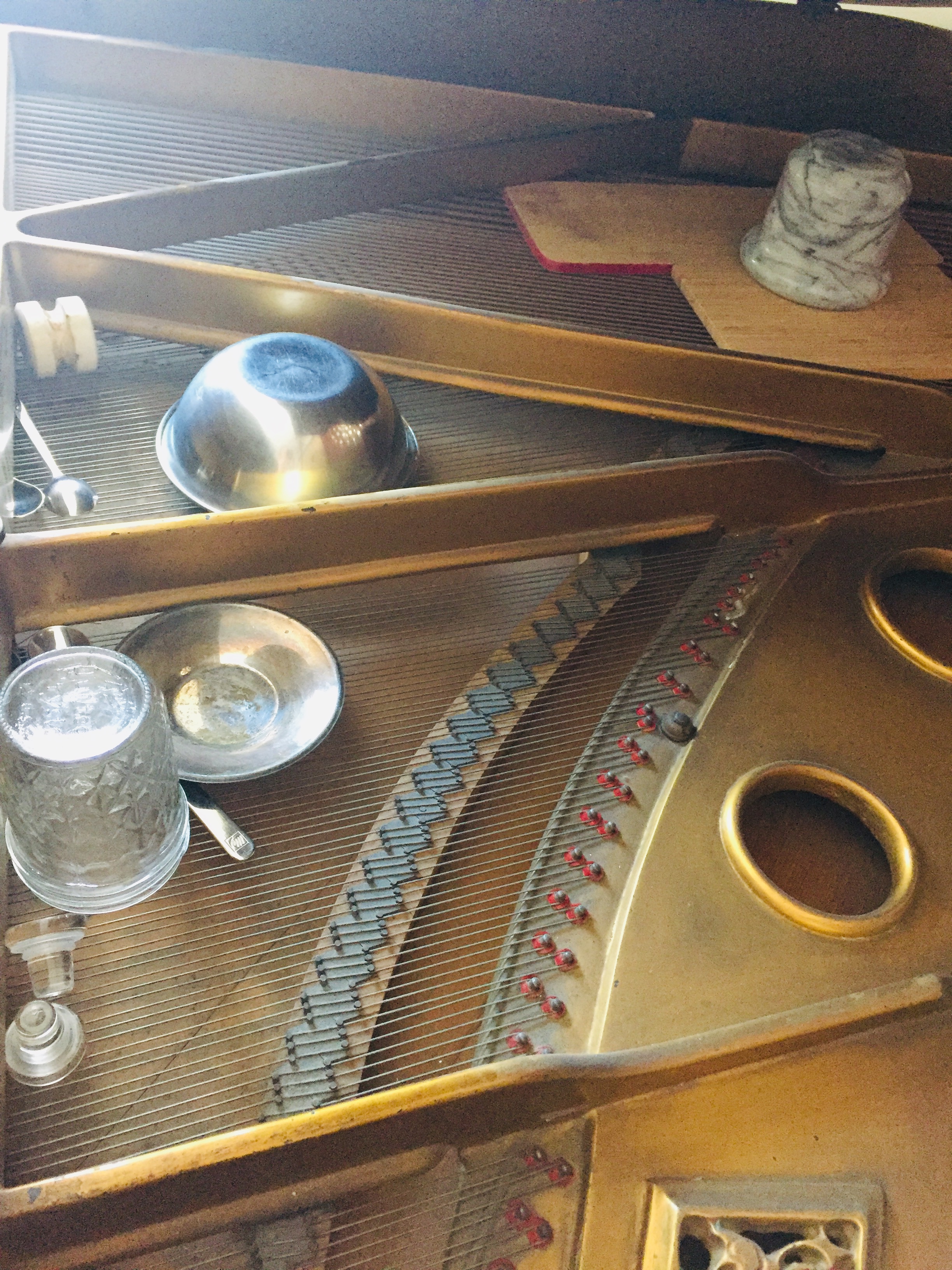
Prepared piano from last night’s rehearsal of the Laughing Garden

The creative process has been fun, an exercise in a discipline of relating. It’s beautiful to experience the piece being re-created with every performance, based on choices and responses of each moment by every individual engaged in the process.

Luciano and I first established the vocabulary so that we can independently create our parts.


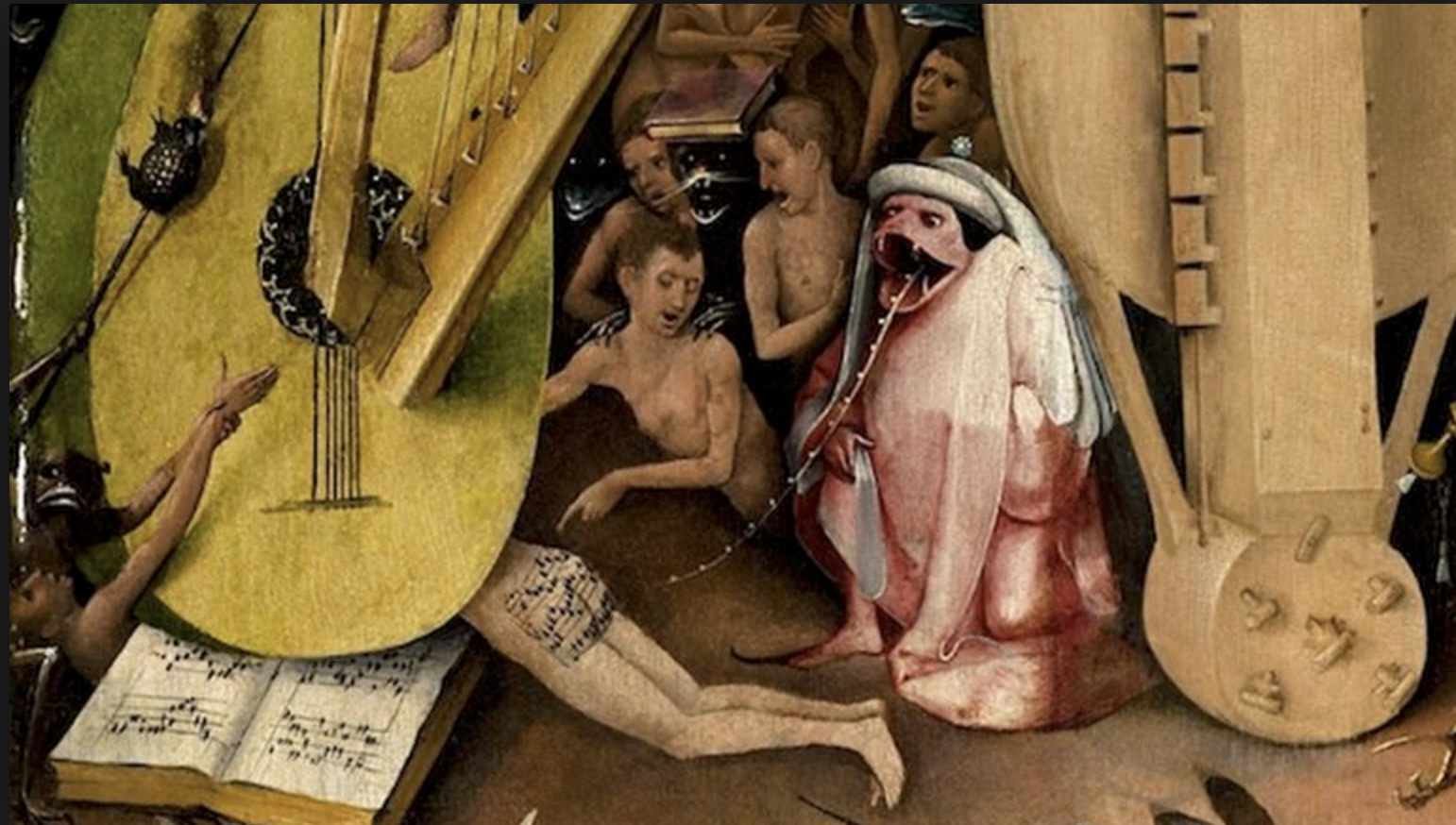
Taking a closer look into the fantastical painting by Bosch I found out about the music inscribed on a sinner’s bottom on the right panel of the tryptic, the Hell. The sound Luciano and I decided to create for the dance is abstract and without any linear musical narrative. At the same time we wanted to have a focal point where musically all kinds of disparate elements come together into a little tune, a phrase, a place of intimacy. And there it was, the little chant, inscribed by Bosch himself waiting to be brought to life; this time in the context of joy and beauty, rather than sin and punishment.

The tune – detail from Garden of Earthly Delights, by Hieronymus Bosch

I see this newest work with Dusan as a curious look into the profusion of life and nature – which is creativity itself. It is funny, fun, unstoppable, rich, fragrant, colorful, and free.

See the details about the show and come see us if you are in New York:
https://www.newyorker.com/goings-on-about-town/dance/dusan-tynek-dance-company

Update, March 11 – We had a blast. Every evening was different, as sound was improvised/live. It was thrilling to have the full house every night; more than 600 people saw the show. Here are a few pictures from the Garden with all its protagonists: the fountain, composer Luciano Chessa and myself, and superhuman dancers Elizabeth Hepp, Tim Ward, Ned Sturgis, Alexandra Berger, Nicole Restani, and Gary Champi.

a different cinderella

XENIA AND THE BISHOP

Story by Aleksandra Vrebalov

Once upon a time, there was a girl whose name was Xenia.  She was smart, strong and had a beautiful, good heart.  She was creative and funny, too.  She loved nature and people.  Her secret passion was to play chess – she learned it from her late mother and grew to be an excellent chess player.  In her free time she made little pieces out of clay, imagining they were her friends.  She was especially proud of a clay chess set she made using her late mother’s jewelry to decorate the pieces.

Her hunger for knowledge and beauty was huge, yet not satisfied.  She was disciplined and curious.  She loved math and astronomy, and often played with animals.  She lived in a home where she sometimes thought she was not understood.  She was expected to play the children’s games and engage in activities with cousins that she did not enjoy so much. Often, Xenia found excuses to play on her own, which made her seem a bit strange. 

One day she learned that there was a masked chess tournament coming up in her town.  She really, really wanted to go.  The tournament was open to everyone, but with two requirements – that 1) they come to play incognito and 2) they bring their own unique chess sets.  Her cousins wanted to go too, so they started private chess lessons to learn the game and to learn it fast.  They disagreed and quarreled on how to decorate the chess sets they got in a store.  Xenia kept quiet about her own original chess set, but often ran into her room to check on it, hidden under an armchair.

It was a weekend when Xenia packed the chess set and left for the tournament.  She put her blue-kitty mask on as she entered the tournament hall.  It was filled with most colorful masks and unusual chess pieces.  Xenia moved with her unique beautiful set through the space like in a dream, winning at all tables!  The figurines seemed alive. There was a sense of magic, of a beautiful order.  She played half a dozen games and finally there was the last encounter with another finalist – someone wearing a pink-bird mask.  They drew the queens to determine who was to play first and with which set, and Xenia’s set was chosen for the last game.

She knew she had to play fast as she needed to be home by dinner time.

The game was fun!  She won and was cheered by everyone.  Other players were coming to congratulate her and the trophy was to be presented to the winner.  But Xenia needed to run home.  She used the moment to quickly pack her set and sneak out as the MC was calling the finalists to get on the stage.  As she ran out, without noticing, she left behind a black bishop from her set.

For days everyone talked about the mysterious winner.  There were funny posters and many social media posts about the unusual clay bishop with a head made of black lava.  Who is its owner?  Where is the tournament winner hiding and why?  There was a prize to be given!  Xenia was shy.  She was so happy that she played so well and with so many good chess players that that in itself was a prize for her.  Her cousins kept talking about the tournament, about the mysterious winner with a blue-kitty mask, and teased Xenia for not participating.  Then one day they saw her clay chess set with a missing piece!  They looked up the black bishop online and yes – it was Xenia’s!  By the time the cousins broke the news, the entire town was already in awe of the secretive chess master.  Xenia’s school friends talked about the winner of the tournament with admiration and curiosity.  There was a sense of wonder and excitement around the stranger who played so brilliantly and then disappeared.  Xenia liked the buzz but thought it would be so awkward to be discovered.

So it happened!  The cousins posted a picture of her chess set with the unusual army of jewel-decorated pawns, knights, and rooks all in order and lined up — with one empty tiny square among them.   By then, everyone knew that it was where the bishop belonged.

The organizers of the tournament announced that the owner of the black bishop was found.  Congratulations poured in from friends, classmates, cousins, neighbors, and strangers!  The golden trophy and the black bishop were now in Xenia’s hands, but the greatest prize was that she learned that her biggest strength was in being herself: in pursuing with freedom and passion what she loved and did best!