After months of traveling, I returned to New York on Thursday and started rehearsing with Dusan Tynek Dance Theatre on Friday for our new show, The Laughing Garden. This is my seventh collaboration with Dusan over 15 years. Our long creative relationship enabled us to expand and grow together trying out different ways to create a dance – from sound coming before choreography, to building music and choreography simultaneously, to choreography coming first, to the current approach of establishing the vocabulary and freely creating music and choreography together in real time, before your eyes.
The Laughing Garden is inspired by Hieronymus Bosch’s Garden of Earthly Delights and is filled with moments of primal energy, joy, some darkness, a lot of playfulness.
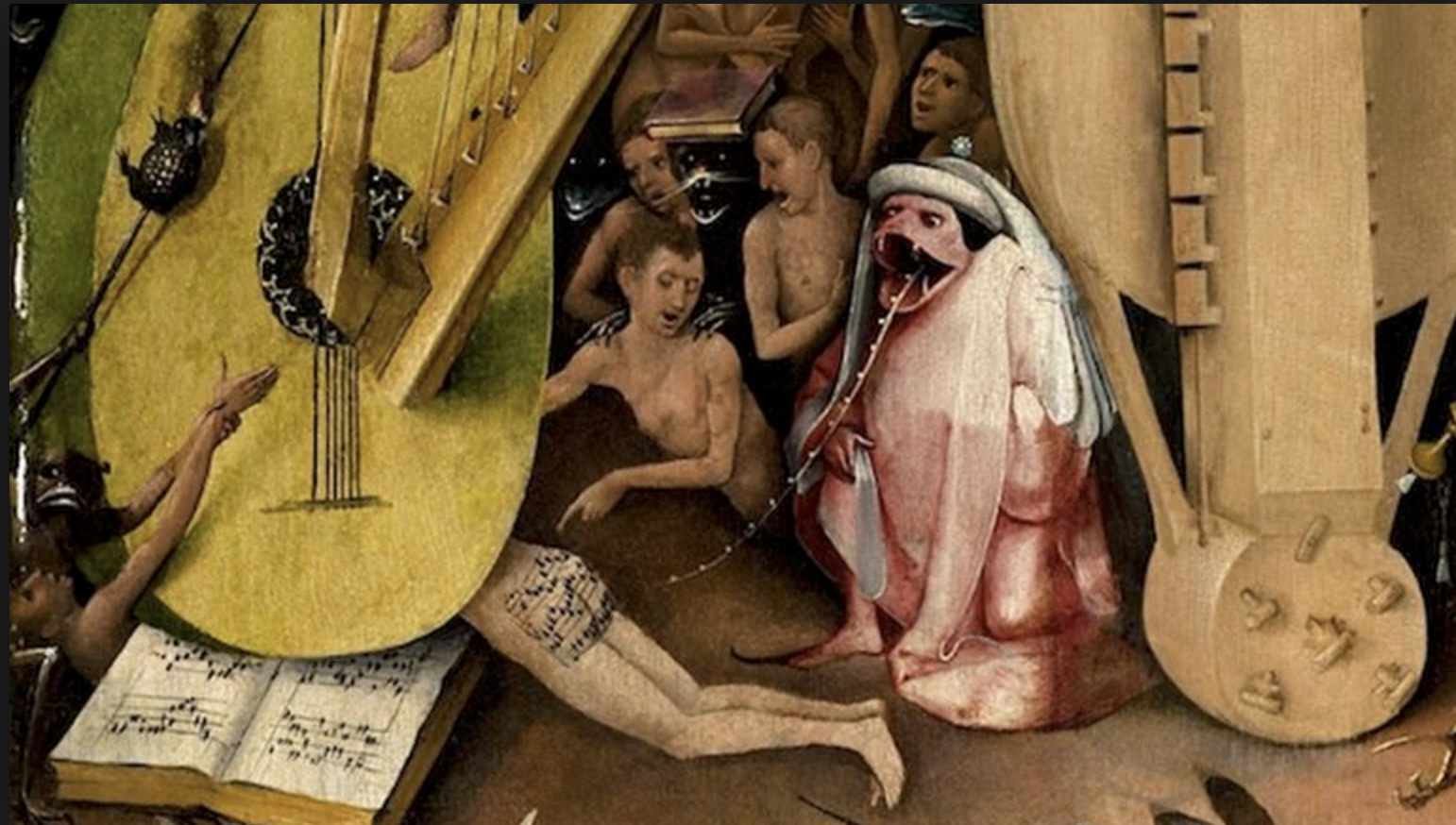
Detail from Garden of Earthly Delights, Hieronymus Bosch
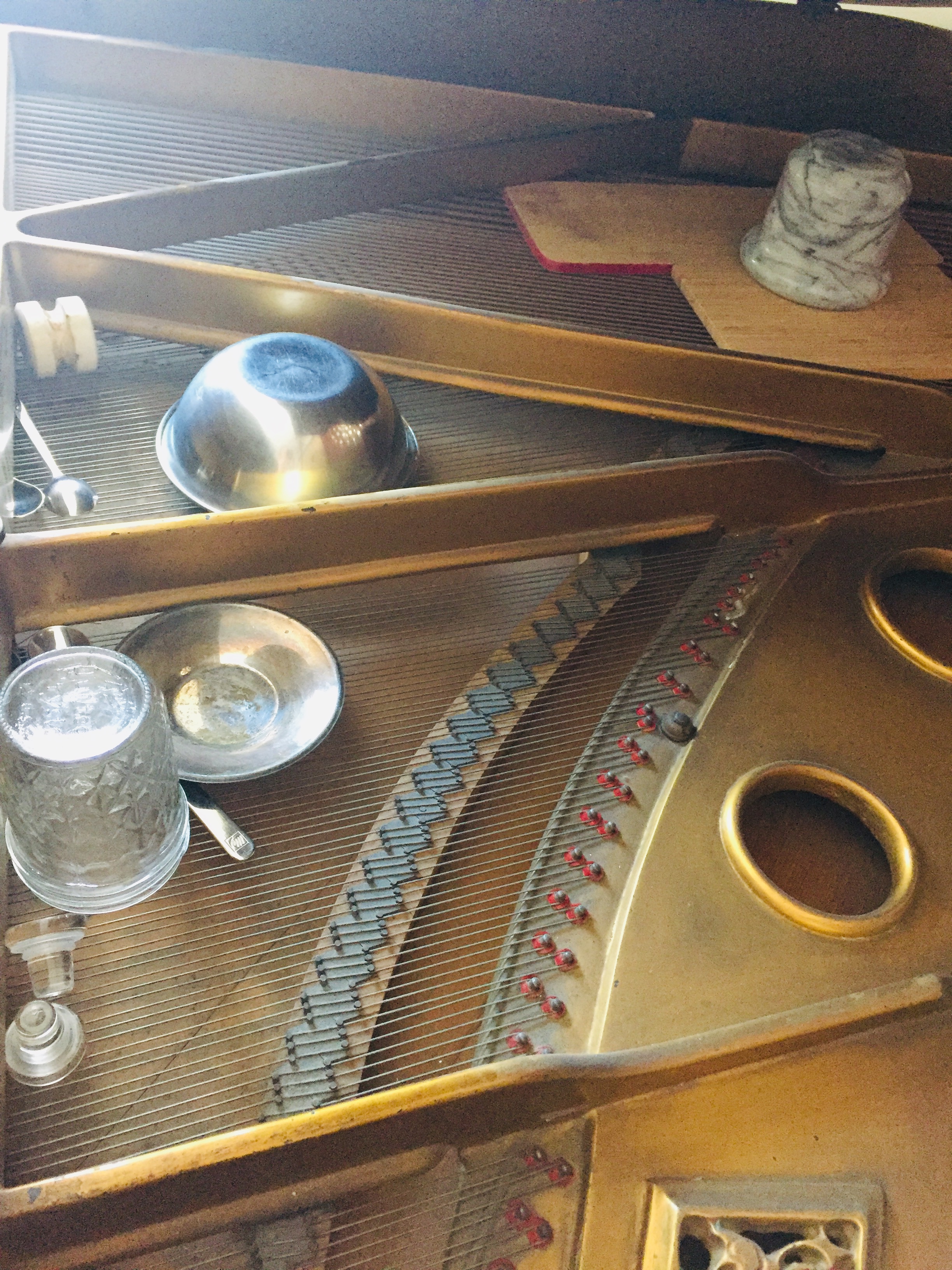
I am thrilled that my friend and a fantastic composer Luciano Chessa will join me in creating a live score for performances. We will be on stage with six dancers and make sounds on prepared piano and other objects, including a water fountain.
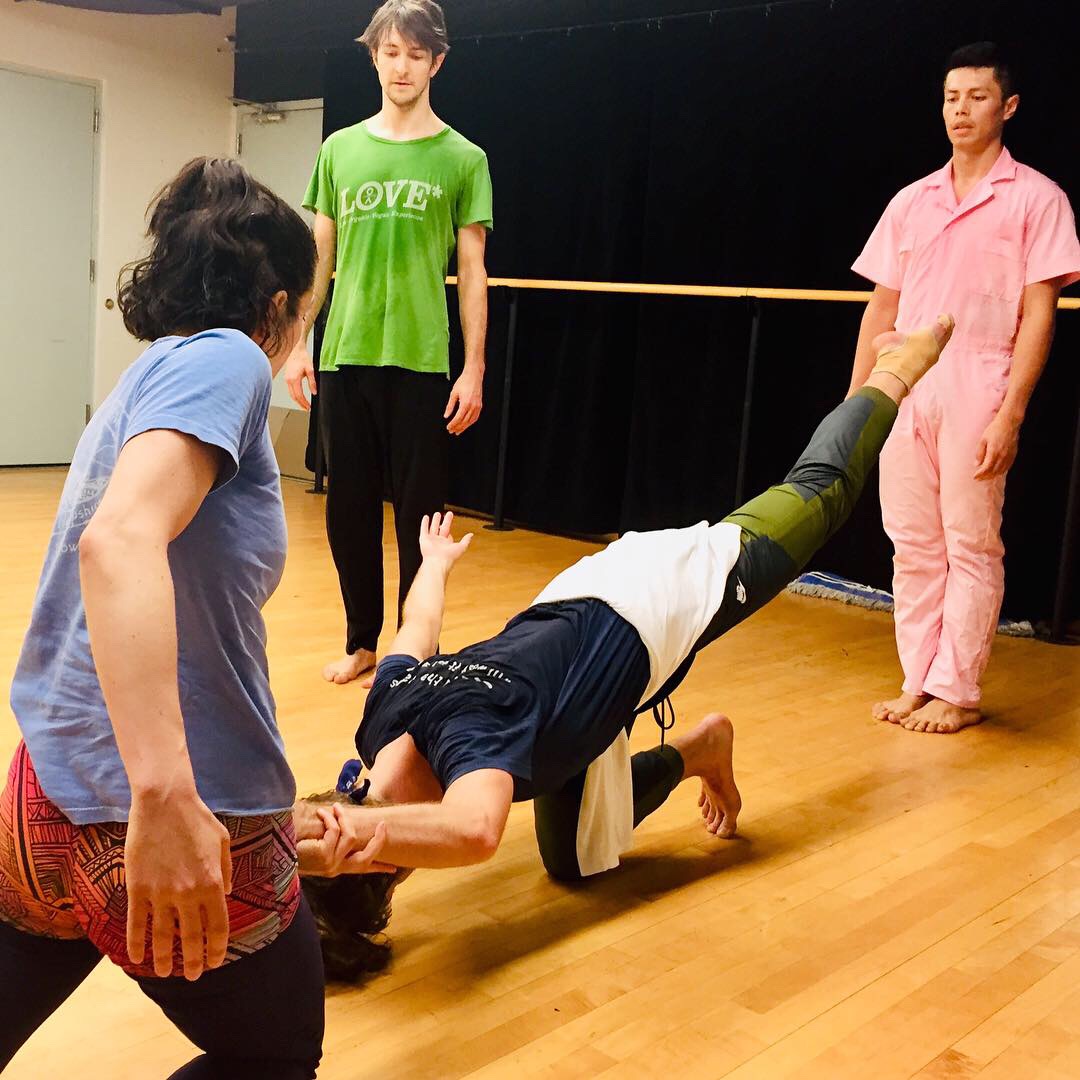
Alexandra Berger, Ned Sturgis, Tim Ward, Gary Champi of Dusan Tynek Dance Theatre rehearsing The Laughing Garden, March 2019Prepared piano from last night’s rehearsal of the Laughing Garden
The creative process has been fun, an exercise in a discipline of relating. It’s beautiful to experience the piece being re-created with every performance, based on choices and responses of each moment by every individual engaged in the process.
Luciano and I first established the vocabulary so that we can independently create our parts.
Taking a closer look into the fantastical painting by Bosch I found out about the music inscribed on a sinner’s bottom on the right panel of the tryptic, the Hell. The sound Luciano and I decided to create for the dance is abstract and without any linear musical narrative. At the same time we wanted to have a focal point where musically all kinds of disparate elements come together into a little tune, a phrase, a place of intimacy. And there it was, the little chant, inscribed by Bosch himself waiting to be brought to life; this time in the context of joy and beauty, rather than sin and punishment.
The tune – detail from Garden of Earthly Delights, by Hieronymus Bosch
I see this newest work with Dusan as a curious look into the profusion of life and nature – which is creativity itself. It is funny, fun, unstoppable, rich, fragrant, colorful, and free.
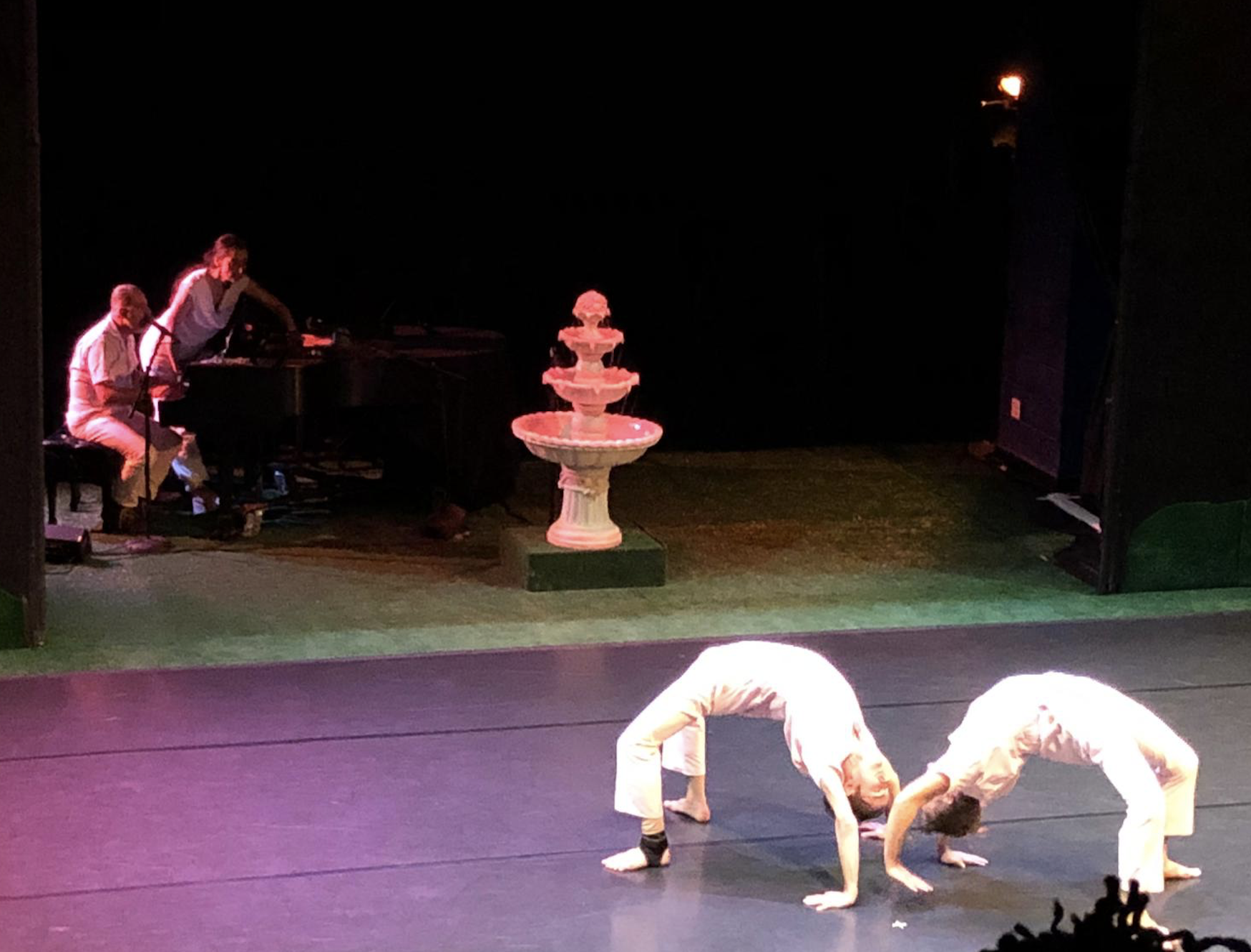
Update, March 11 – We had a blast. Every evening was different, as sound was improvised/live. It was thrilling to have the full house every night; more than 600 people saw the show. Here are a few pictures from the Garden with all its protagonists: the fountain, composer Luciano Chessa and myself, and superhuman dancers Elizabeth Hepp, Tim Ward, Ned Sturgis, Alexandra Berger, Nicole Restani, and Gary Champi.
This gray, cracked road is like an elephant. It takes me up and down on its thickskinned back. I look at my bouncy shadow – a smiling child on a ride through the wilderness.
If you are fortunate in life there will be love where you expect it, and if you are really fortunate, there will be love where you don’t expect it. This was my theme for 2018 and I was really fortunate. This year I made music with hundreds of young people in unrelated projects on three continents. Among them there were the Nusaybin Choir in Turkey with a dozen children, mostly girls displaced by war, two hundred girls of the SF Girls Chorus, young musicians of Mikka Quartet in NYC who I had met before they were teenagers, and students from the music high school I attended 30+ years ago in my hometown Novi Sad.
Rehearsals: Nusaybin Youth Choir in Mardin, Turkey, and SF Girls Chorus with Kronos Quartet in San Francisco
All brilliant, eager to
participate and engage, these young people come from the widest possible range
of backgrounds and life experiences: from the Middle East and not knowing where
their family members are, to Manhattan and San Francisco, living
the liberal values of the Western world. Traveling as much as I have
this year, I often have the urge to connect those experiences, to integrate the
worlds and knowledge, not only for myself but for others too, in hope of better
understanding the complexities of our time. So in one of my such
fantasies, I imagined that ten years from now somewhere in the peaceful world
some of those kids’ paths cross. They have a conversation and of course
they immediately feel close. They realize what they have in common: the
love of music and the experience of making NEW music. As they relay their
specific memories of performances they gave a girl says – once we shouted our
names and words like love and freedom and peace in an outdoor concert; it was
in 2018, in a war zone, a town where I was a refugee, where concerts would get
interrupted because of Azaan and women covered their heads.
Well, says the other, we
have lived in peace all along, but it’s funny, it was also 2018 and two hundred
of us shouted Holy All for about three minutes in a concert in my hometown, San
Francisco.
As I contemplate that
fantasy I am profoundly grateful for every moment of connection with those
young musicians. I asked girls from Nusaybin to shout their names into the open
sky above Mesopotamia. In rehearsal they
giggled and spoke them shyly, and with every repetition there was more exuberance
and power in their voices. We also
called for what we desired most – peace, love, and freedom, in Kurdish, Arabic,
Turkish, English, and it was profound and urgent. Similarly
it
felt crucial to proclaim us all holy in Allen Ginsberg’s San Francisco
while in the US and across the world we get divided, excluded and
killed
because of gender, race, or religion. These kids, with their passion
and
beauty weren’t performers, they were the life and the essence of the
music we
made together. They have given me so much hope for our world and made
2018
unforgettable for me.
Mardin, Turkey, music lesson and lunch with children at the Flying Carpet Festival directed by Sahba Aminikia
I am also grateful to all of
you who in many different ways made these experiences possible. 23 ensembles played
17 pieces of mine in 13 different countries in 70 performances registered this
year. From those of you who I have worked with for many years to those
who I never met in person – THANK YOU.
Here’s a video from one of the performances with the Nusaybin Choir and the Kurdish bard Abdurrahman Ciziri at the Flying Carpet Festival in Mardin last September.
I wish you a healthy, happy, and filled with love 2019!!
Once
upon a time, there was a girl whose name was Xenia. She was smart, strong and had a beautiful,
good heart. She was creative and funny,
too. She loved nature and people.
Her secret passion was to play chess – she learned it from her late mother and
grew to be an excellent chess player. In
her free time she made little pieces out of clay, imagining they were her
friends. She was especially proud of a clay chess set she made using her
late mother’s jewelry to decorate the pieces.
Her
hunger for knowledge and beauty was huge, yet not satisfied. She was disciplined and curious. She loved math and astronomy, and often played
with animals. She lived in a home where
she sometimes thought she was not understood.
She was expected to play the children’s games and engage in activities
with cousins that she did not enjoy so much. Often, Xenia found excuses to play
on her own, which made her seem a bit strange.
One day
she learned that there was a masked chess tournament coming up in her
town. She really, really wanted to go. The tournament was open to everyone, but with
two requirements – that 1) they come to play incognito and 2) they bring their
own unique chess sets. Her cousins wanted to go too, so they started
private chess lessons to learn the game and to learn it fast. They
disagreed and quarreled on how to decorate the chess sets they got in a
store. Xenia kept quiet about her own original chess set, but often ran
into her room to check on it, hidden under an armchair.
It was
a weekend when Xenia packed the chess set and left for the tournament.
She put her blue-kitty mask on as she entered the tournament hall. It was filled with most colorful masks and
unusual chess pieces. Xenia moved with
her unique beautiful set through the space like in a dream, winning at all
tables! The figurines seemed alive. There
was a sense of magic, of a beautiful order. She played half a dozen games
and finally there was the last encounter with another finalist – someone
wearing a pink-bird mask. They drew the queens to determine who was to
play first and with which set, and Xenia’s set was chosen for the last game.
She
knew she had to play fast as she needed to be home by dinner time.
The
game was fun! She won and was cheered by everyone. Other players were coming to congratulate her
and the trophy was to be presented to the winner. But Xenia needed to run home. She used
the moment to quickly pack her set and sneak out as the MC was calling the
finalists to get on the stage. As she ran out, without noticing, she left
behind a black bishop from her set.
For
days everyone talked about the mysterious winner. There were funny posters and many social
media posts about the unusual clay bishop with a head made of black lava. Who is its owner? Where is the tournament winner hiding and
why? There was a prize to be given! Xenia was shy. She was so happy that she played so well and
with so many good chess players that that in itself was a prize for her. Her cousins kept talking about the
tournament, about the mysterious winner with a blue-kitty mask, and teased Xenia
for not participating. Then one day they
saw her clay chess set with a missing piece!
They looked up the black bishop online and yes – it was Xenia’s! By the time the cousins broke the news, the
entire town was already in awe of the secretive chess master. Xenia’s school friends talked about the
winner of the tournament with admiration and curiosity. There was a sense of wonder and excitement
around the stranger who played so brilliantly and then disappeared. Xenia liked the buzz but thought it would be
so awkward to be discovered.
So it
happened! The cousins posted a picture
of her chess set with the unusual army of jewel-decorated pawns, knights, and
rooks all in order and lined up — with one empty tiny square among them. By then, everyone knew that it was where the
bishop belonged.
The
organizers of the tournament announced that the owner of the black bishop was
found. Congratulations poured in from friends,
classmates, cousins, neighbors, and strangers!
The golden trophy and the black bishop were now in Xenia’s hands, but
the greatest prize was that she learned that her biggest strength was in being
herself: in pursuing with freedom and passion what she loved and did best!
Landed into my hometown, walking the long forgotten but familiar streets. I know I belong, but the feeling of not being steeped into the fabric of that very reality is tangible. Everyone’s busy, people passing by me with some destination in mind. My attachments are few. I walk slowly and aimlessly in my new old life and for a moment pick a thing to do – I give blessings to everyone who passes by me.
It would usually be on December 30th that on the way home from work my parents would bring in the Christmas tree. Strong and furry, it would be six to seven feet tall, so wide that my sister and I could not hold hands around it. It was always a little difficult to manoeuvre it into the center of the house and place it next to the stairs. My dad would handle it with his gloves on, with my mom moving behind him, helping him straighten the tree and sometimes trimming a few pointy branches. My sister Maja and I, sitting high up on the stairs, would be very close to the top of the tree, sometimes holding it, wanting to be helpful in making it stand straight, discussing the width or richness of twigs and needles on its very top. The main crownlike ornament would be placed there, often a special task: to fit it on without disturbing the tree’s balance, surround it by glistening smaller ornaments, and try not to overdo it.
The large old cardboard box was kept somewhere deep in my parents’ bedroom wardrobe – in it, hidden among cotton balls and felt cloths, were most wonderful ornaments. Glass birds on coiled little legs that once attached would rock on the tree, one glassy Santa with a powdery white beard and a furry coat drizzled with sparkle, a tiny perfect bike made of wire and little beads, an exotic dancer made of dark yarn wearing a straw-skirt, dozens of ancient, hardened salon-candy, in shiny, silky, pastel color wraps, that we children were always advised not to eat. Secretly, we would, with a renewed disbelief that something so pretty could taste so bad. Only once that I remember, we made a trip to an old fashioned confectionery boutique and replaced the salon-candy from my mother’s childhood with large, new sweets covered in bright colored shiny paper.
The tree decoration day was a special day. The moment when the cardboard box was empty and we finally pulled the string of tiny lights out and spiraled it around the tree felt like some big time Ownership. Our tree. Our ornaments. Our lights. Our house. Our life. Every year we would add one or two new pieces to the ornament collection. Replacing old, damaged ones was never easy. Each came with a story, and history, some were reused for decades and were handed to us by our grandmother. There was one big golden hollow banana made of the thinnest imaginable glass, probably in the 1950’s, that lost its lower third. Its inside was like a tunnel of mirrors with my eye and nose reflecting in liquid shapes while I explored it losing track of time. We tried to hang those old ones at the back of the tree or turn them so that cracks would not be visible. We would examine them endlessly before we would decide, and usually it was my mom’s call, that we were ready to part with them.
After all was done the living room would be vacuum cleaned, outside was already dark, and the lights on the tree would be on, slowly pulsing. The tree was alive.
Its roots, in a pot filled with soil and yarn, were surrounded by a string of holiday cards. The arrangement of holiday cards was a creative way of covering the pot, but also a display of my family’s ways of being rooted across time and place – in friendships, family ties, and professional relations.
December of 1987 was different, although the whole family really tried hard to keep the usual structure of holiday times. My mom had already been in the hospital in another city for two months. I remember thinking that the hardest thing over the holidays when all families gather was to have your loved one away and ill. But, we got the tree, Maja and I decorated it just like every year, and we cleaned the house as if our mother’s recovery depended on it. This was the first time ever that with her on the phone guiding us from the hospital, we made a variety of truffles and cookies that came out great. She insisted we do it without her.
It was before the time of digital cameras and smart phones, so my mom never saw that tree and our neat, decorated house. She tried and praised the sweets we made though, as we packed them and sent them to her with our dad who spent the New Year’s Eve in the hospital. Mom died on January 4 and we buried her two days later, on the eve of Serbian Christmas.
Our tree. Our ornaments. Our lights. Our house. Our life. Everything had gone into pieces that night of January 4. Maja and I dismantled the tree fast and like in a trance the same night, with still fresh needly branches hurting our hands. We buried the box with ornaments back into the depth of our parents’ wardrobe, hugging bundles of our mother’s clothes that were in our way. The sweets we made were served to whoever came to see us after hearing of our mom’s passing.
I don’t remember several holidays after that. I believe that, like it happens when tragic loss hits unexpectedly, we survived on dragging along the happiness and stability of others. Unable to recreate the life as we’ve known it, we were going to other people’s houses, to friends and cousins, whose lives seemed whole, unbroken. And for a while life, comfortable and safe, seemed to be happening elsewhere – in neighbors’ houses that I knew well, but never before longed for their kind of domesticity, or behind lit windows of strangers that I would pass by on my way home from school. Several years later, in my early twenties I moved out of the family home, and soon after there were New Years in San Francisco, and then in Prague. I arrived in both places not knowing anyone. A foreigner, an immigrant, an artist, I was finding strength in solitude, in not belonging, in being exiled from domestic happiness, first by my mother’s death, then by a string of wars involving my home country and then, internally – by feeling different and inadequate. Between 1995 and 2002, I lived in more than a dozen places, in four countries, on both coasts in the US, as well as in Michigan. For most of the time during those years, places and friendships were stimulating and exciting, but too new for me to feel rooted. Moving around freely and not establishing deep ties, I became something akin to The Traveler described in the Book of Changes. Not attaching and keeping away the symbols of stability and belonging were ways to survive emotionally. And then the point had come when another thought from the Book of Changes’ Traveler started to ring true: “Though being the wanderer offers you a certain freedom from being judged by your history, you also have no history to fortify you.”
It was 2001 in Ann Arbor when my landlady Melanie McCray showed up one day with a Christmas tree and decided to decorate the house that I shared with her. She was somewhat of a stranger in her own life, traveling often, not having a steady job, and without a family. She would run into the house in the middle of the day, sit on the edge of a chair and eat lunch still wearing her coat. And then after the meal, realizing that there was no reason to leave the house soon again, she’d take it off. We were family to each other. There was snow, there was a wood stove in the living room, there was a large glass wall overlooking the backyard and flickering lights on neighbors’ roofs, there was our big Christmas tree, a little aslant and very unique, visible from the sofa, from the dining table, from the piano bench, from the front room, from the chair on which I used to sit while composing, and visible at all times from my heart’s core — when in classes, or walking home tired late at night in Michigan cold. I knew what it meant: the garlands of light and pine branches all over staircase and on coffee tables, waking up to the scent of evergreens in the morning, still dark outside, and plugging the little string lights in while the coffee was being made — I felt at home again. Melanie felt at home again too. We were having guests over, we rushed home for meals, spent evenings tending a fire in the woodstove, or were warming up by our tree after shoveling the snow.
Starting with Melanie and over the last fifteen years my holiday routines have become less discriminating and healthier. Traveling over holidays meant enjoying the privilege and freedoms of an outsider – very few or no gifts to give or receive, no excessive shopping, no holiday nesting. With the rest of my family being overseas, staying at home in New York by myself still meant feeling cozy and warm, with a cheerful tree in the apartment and another one out in the park right in front of my window, meals with friends, reading, watching films, being often in solitude, productive and comfortable in all ways.
In socialism, Christmas tree was simply called the pine. It had nothing to do with Christ or religion. It was an object in a ritual ushering a new year, and a marker of well being and normalcy.
I do not see the world through the eyes of the I-Ching’s Traveler any more. As a testament to stability desired and regained over time, after the years of wondering I am settled in two cultures, with double citizenship and homes in two countries. Still, I am very aware of the fragility of that feeling of being rooted, of belonging, and creating happiness with others.
To celebrate, to create a ritual, to greet life with enthusiasm, adding lights, and color, to infuse life and yes, death, with love, with something festive and why not foolish, to wake up to a different look, making it special, making anything special, making everything special, to move on and be thankful for it, to experience it at one’s own home and heart instead of living it vicariously, to love life and breathe it fully, to keep it going so that it can keep going…this is what our last December you taught me Mom.